

Table of Contents
- Step 1: Match the Bag to Your Daily Commute and Workload
- Step 2: Identify the Best Leather for Bags That Last
- Step 3: How to Tell If a Leather Bag Is Good Quality Before You Pay
- Step 4: Check Straps, Stitching, and Hardware for Wear Resistance
- Step 5: How Long Should a Leather Handbag Last?
- Step 6: How to Care for a Leather Work Bag So It Holds Its Shape
- Step 7: Weigh Total Cost of Ownership Before You Commit
- Conclusion: Choosing Durable Leather Work Bags With Confidence
- Frequently Asked Questions
Last Updated: October 19, 2026
Step 1: Match the Bag to Your Daily Commute and Workload
Choosing durable leather work bags starts with one honest question: what do you carry, and how far does it travel each day? A polished tote can fail fast if you stuff it with a laptop, files, and a water bottle on a two-mile walk to the train.
This guide walks through the checks that separate a bag that lasts from one that sags by spring.
What to Measure Before You Buy
Start with the load, not the look. Weigh your laptop, charger, planner, and daily essentials on a kitchen scale, then measure your laptop's length and width and add at least 2 cm of clearance on each side so it slides in without scraping the lining.
Next, measure your commute. A short car ride tolerates a structured tote with a single top handle; a long walk, bike ride, or train transfer calls for a crossbody strap and a bag that stays light when empty.
| What to Measure | Why It Matters | Target |
|---|---|---|
| Laptop size plus 2 cm clearance | Prevents lining and corner wear | Fits with room to spare |
| Loaded weight | Protects straps and shoulders | Under 4 kg loaded |
| Commute length and mode | Decides handle vs. crossbody | Match strap to travel |
| Bag dimensions | Confirms real capacity | Fits your largest item flat |
Step 2: Identify the Best Leather for Bags That Last
The best leather for bags is full-grain leather, because it keeps the hide's natural grain intact and develops a rich patina instead of cracking.
Top-grain leather has its surface sanded and finished for consistency. It resists staining well, but sanding removes some of the strongest fibers.
Genuine leather is a broad label that can cover lower-grade splits. It tells you the material is real leather, not how durable it is.
Full-Grain, Top-Grain, and What the Label Really Says
A "genuine leather" label is honest but vague: it confirms real leather without promising a grade. Look instead for full-grain, top-grain, or natural grain, and ask what finish sits on top.
Polished calfskin, like the leather in our Nicole Tote in Brown, gives you a smooth, professional surface with real leather underneath, a finish that holds up in an office, where the main threats are desk edges and daily handling rather than trail mud.

Step 3: How to Tell If a Leather Bag Is Good Quality Before You Pay
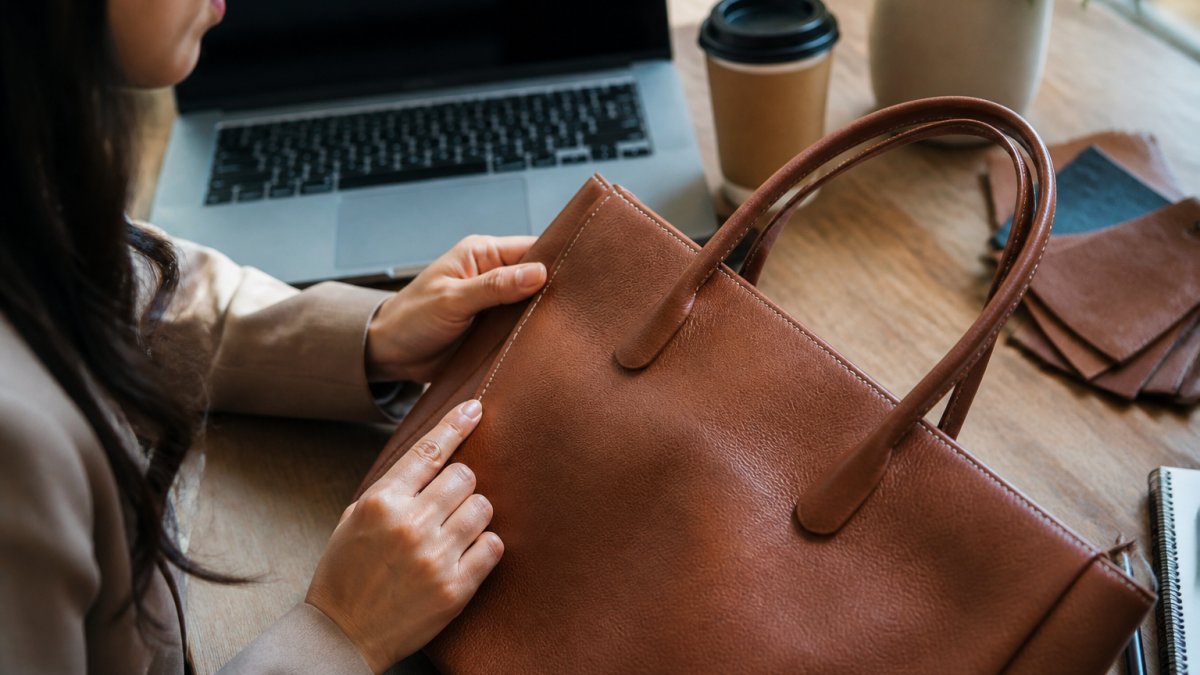
You can judge leather quality before you pay by running a repeatable inspection: check grain, thickness, stitching, edge finishing, hardware, and lining in that order. The checks below turn vague advice into a five-minute routine you can do in a store or from high-resolution product photos.
1. Grain: Look for Irregularity, Not Perfection
Full-grain leather keeps the hide's natural surface, so the grain should look uneven, visible pores, subtle color variation, and a pattern that does not repeat like a printed texture. Run your thumb across it at an angle: real grain catches light unevenly, while a plastic-coated or embossed surface reflects light in a flat, uniform sheet. Press gently with your thumbnail; a healthy hide springs back, while a thin split or heavily corrected leather stays dented or feels papery.
2. Thickness: Feel the Body, Not Just the Surface
Thickness is the single best predictor of how a bag will hold its shape under a laptop load. Pinch the leather at the base and top edge: a work bag body should feel substantial. Thicker is not always better, though, overly stiff leather can crack at fold points, so look for a hide that is firm but still flexible.
3. Stitching: Count Density and Check the Stress Points
Stitching is where most bags fail first. Look for straight, evenly spaced stitches with no loose threads, skipped stitches, or wandering lines; dense stitching distributes load better than sparse stitching. Pay closest attention to the strap anchors, zipper tape, and base corners, since those joints carry the most weight. Give a strap a firm but gentle tug; if the stitching gaps or the leather puckers around the seam, that is where the bag will tear.
4. Edge Finishing: Painted, Burnished, or Raw
Turn the bag over and inspect the cut edges. Painted edges should be smooth, even, and free of drips or cracks. Burnished edges should look sealed and slightly glossy. Raw edges should be tight and clean, not fuzzy or fraying. Edge finishing is a reliable proxy for overall construction care.
5. Hardware: Test the Zip and the Weight of the Metal
Zippers should glide without catching and feel solid when you pull the slider. Metal fittings should feel dense rather than hollow; hollow hardware dents and flakes. Check that rivets and D-rings are firmly seated and that the zipper tape is stitched, not glued, to the leather. On a work bag, the zipper and strap anchors take the most daily abuse, so test both before you commit.
6. Lining: The Hidden Durability Layer
A sturdy lining protects the leather from the inside and keeps the bag's shape. Look for a tightly woven fabric or smooth leather lining stitched, not glued, to the shell. Run a finger along the interior seams.
Step 4: Check Straps, Stitching, and Hardware for Wear Resistance
Strap strength decides whether a durable bag survives a heavy load.
Hardware is the next weak point. Silver-toned accessories and a smooth zip closure, as on the Liza Tote in Black, signal hardware built for daily opening and closing.

Seam strength matters most where the strap meets the body. Give that joint a firm tug. If you see gaps in the stitching or the leather puckering, the bag will likely fail there first.
Step 5: How Long Should a Leather Handbag Last?
A well-made leather handbag should last five to ten years of regular use, and longer with proper care.
Longevity depends on four factors: leather grade, stitching quality, lining durability, and how hard you are on the bag.
Daily wear is the real test: bags carried five days a week with a laptop age faster than weekend bags. If you commute daily, buy for durability first and style second, then find a design that delivers both.
Step 6: How to Care for a Leather Work Bag So It Holds Its Shape
Care for a leather work bag by conditioning it every two to three months, storing it stuffed and upright, and keeping it away from direct heat.
Wipe the surface with a soft, dry cloth after heavy use. Apply conditioner sparingly, work it in with a clean cloth, and buff off the excess. Skip silicone-heavy products, which can clog the grain over time.
Store the bag filled with tissue or a soft insert so it keeps its shape, in a dust bag away from radiators and sunny windows.
Step 7: Weigh Total Cost of Ownership Before You Commit
Total cost of ownership is the purchase price plus care and repair costs, divided by the years you actually carry the bag. A $135 tote that lasts six years costs about $22 a year, while a cheaper bag replaced every 18 months costs more in the long run. That math changes how you shop: instead of chasing the lowest sticker price, compare cost per year across the bags you are considering.
The Four Inputs That Decide Long-Term Value
Purchase price. The sticker price is only the starting number. A bag that costs twice as much but lasts three times as long is the cheaper bag per year.
Expected lifespan. Base this on leather grade, stitching quality, and lining durability, the checks in Step 3.
Care and repair costs. Budget for conditioner every two to three months and occasional professional repair of straps, zippers, or linings.
Warranty and repairability. Check what the maker covers and for how long. Ask whether the maker offers repairs or replacement parts.
How to Run the Math
- Write down the purchase price.
- Estimate the years you expect to carry the bag, based on the construction checks.
- Add estimated annual care costs, conditioner and occasional repairs.
- Divide the total by the expected years.
A $135 tote that lasts six years with minimal care costs about $22 a year.
Our Nicole Tote in Navy weighs just 0.65 kg and measures 30 cm by 26 cm by 9 cm, which keeps the daily load light while still holding the essentials. For commuters who carry more, the Zesty Backpack Tote in Black spreads weight across both shoulders and adds two compartments for organization.

| Bag | Price | Empty Weight | Best For |
|---|---|---|---|
| Nicole Tote | $135 | 0.65 kg | Light daily carry |
| Liza Tote | $179 | Not listed | Laptop and files |
| Zesty Backpack Tote | $165 | 0.70 kg | Long commutes |
Conclusion: Choosing Durable Leather Work Bags With Confidence
The challenge with durable leather work bags is that quality hides in details most shoppers never check: grain, edge finish, strap anchors, and stitching density.
At Grazia Bella, we craft our bags from 100% genuine Italian leather, keep them lightweight for comfortable daily carry, and design each piece for the modern professional who wants polish and organization in one bag. Every piece is made in Italy.
Shop all colors and find the work bag that carries you through your commute, your meetings, and everything between.
Frequently Asked Questions
What should I look for in a durable leather work bag?
Check four things before buying. First, the leather: full-grain or top-grain hides with tight, even grain. Second, construction: double-stitched seams, reinforced handle attachments, and metal hardware that feels solid rather than plated. Third, fit: a laptop compartment and interior pockets that match what you carry daily. Fourth, weight: a bag that is already heavy when empty gets heavier on a commute.
How long should a leather handbag last with regular use?
A well-made leather handbag used daily typically lasts five to ten years. The variables are leather grade, how often you condition it, and whether you rotate bags. Storing the bag stuffed and in a dust bag, cleaning spills promptly, and conditioning two to four times a year are the habits that push a bag toward the upper end of that range.
Are full-grain leather bags more durable than other leather bags?
Yes, in general. Full-grain leather keeps the hide's natural surface intact, so the fibers stay tightly connected and resist cracking. Top-grain is sanded slightly and remains a solid choice.
How do I care for a leather work bag so it lasts longer?
Wipe the bag with a dry cloth weekly to remove dust and oils from your commute. Clean spills immediately with a slightly damp cloth and let the bag air dry away from direct heat. Apply a leather conditioner two to four times a year, depending on climate and use. Store the bag stuffed with tissue in a dust bag when not in use, and avoid hanging it by a single strap for long periods. These steps protect the finish and keep the shape intact.
Leather tanning and hide grading guidance from the United States Department of Agriculture
Federal Trade Commission guidance on accurate leather and textile labeling
American Leather Chemists Association resources on leather properties and testing